What Should You Charge Per Square Foot For A Deck
Ask ten deck builders what they charge per square foot and you will get ten answers between fifteen and sixty dollars. Ask them how they arrived at the number and most will tell you some version of the same thing. It is what the last guy charged, it is what the market will bear, or it is what they have always charged and nobody has walked away yet.
That is a dangerous way to price work. Not because the number is wrong, but because a number you cannot break apart is a number you cannot defend when lumber moves, and one you cannot adjust when a job turns out harder than the last one.
Here is what the published numbers actually measure, why they will not match your jobs, and how a working contractor builds a square foot price out of his own costs.
The national numbers measure a deck you probably are not building
The most quoted figure in this trade comes from the Cost vs. Value Report, published annually by Zonda Media and carried by the Journal of Light Construction. It is the source behind almost every article you have read about what decks cost.
Here is the part that gets left out. The report prices one specific deck, and the specification is public. It is a 16 by 20 foot deck, 320 square feet, on pressure treated joists supported by 4x4 posts anchored to concrete piers, with pressure treated boards in a simple linear pattern. It also includes a built-in bench and a planter made from the same decking material, stairs assuming three steps to grade, and a complete railing system of pressure treated posts, rails, and balusters.
Read that list again. A bench, a planter, stairs, and a full railing, all folded into a 320 square foot number.
If you divide that total by 320 and compare it to your plain rectangular deck with no bench and no planter, you are comparing two different products and concluding the report is wrong. It is not wrong. It is measuring something else.
There is a second problem worth knowing about. Secondary sites republish these figures constantly and they do not agree. In the past year, articles citing the same wood deck addition have published cost recouped percentages ranging from roughly fifty percent to roughly ninety five percent. Those cannot all be true at once. Some quote older editions, some mix national and regional figures, and some are copying each other. If you are going to use a published number in front of a homeowner, get it from Zonda or JLC directly and note the year.
What a square foot price actually contains
A square foot price is not a price. It is the output of a calculation with three parts.
Material. Everything that ends up on the job: framing lumber, decking, fasteners, joist hangers, post bases, concrete, flashing, and the railing if the railing is in your number. This is the only part with a receipt.
Labor. Your hours and your crew's hours at a burdened rate that includes payroll taxes, workers compensation, and any benefits you carry. The rate you pay a framer is not the rate that framer costs you.
Margin. What the company earns after material and labor are covered. Margin is not your pay. Your pay is labor. Margin is what the business keeps for carrying the risk, the truck, the insurance, and the weeks you spend quoting jobs you do not win.
Real numbers from a real deck builder
Kevin Goodwin builds decks and fences in Alabama and runs operations at Yardstick. These are his numbers, not an industry average, and they are specific to his market. Yours will differ. The structure is what transfers.
A standard ground level deck, nothing fancy, straight rails and steps:
- Material: $15 per square foot
- Labor: $20 per square foot
- Margin: 15 percent
- Lands at roughly $40 per square foot
A complex deck, higher off the ground where the labor gets harder:
- Material: $18 per square foot
- Labor: $26 per square foot
- Margin: 15 percent
- Lands at roughly $52 per square foot
Tear off and haul away: about $10 per square foot, which covers the demolition and the dumpster.
Add a roof or screen it in and his number runs from $40 all the way to $75 a square foot, depending entirely on what the homeowner wants.
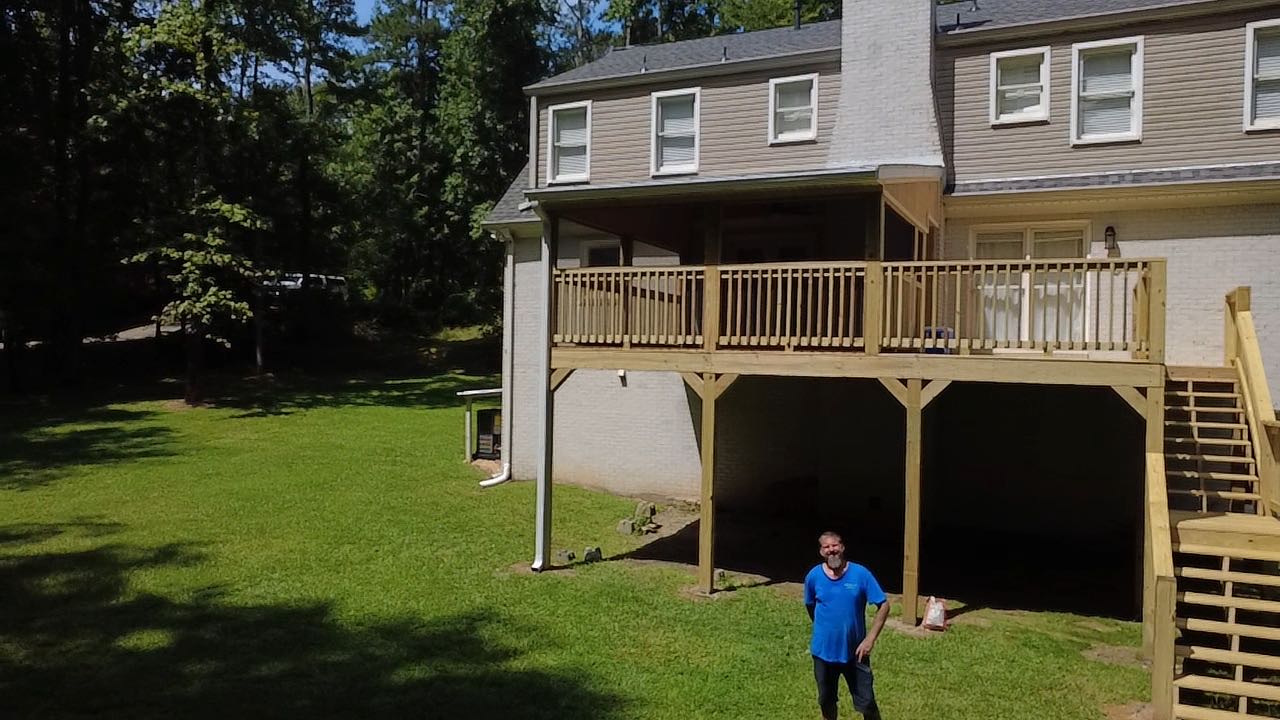
Notice what changes between the standard deck and the complex one. Material barely moves, from $15 to $18. Labor moves hard, from $20 to $26. That is the whole lesson in two lines. Height and complexity are labor problems, not material problems. A contractor who prices difficulty by marking up material is solving the wrong side of the equation.
Margin and markup are not the same thing, and the difference is real money
Kevin's 15 percent is margin, meaning fifteen percent of the final price. That is not the same as adding fifteen percent on top of cost, and contractors lose money on this distinction constantly.
On his standard deck, material and labor come to $35 per square foot. Mark that up fifteen percent and you get $40.25, but your actual margin is thirteen percent. To hold a true fifteen percent margin you divide by 0.85, which puts the price at $41.18.
The gap looks small on one square foot. On a 400 square foot deck it is real money, and it compounds across every job you run for the rest of the year.
If you are pricing by markup and calling it margin, you are quietly earning less than you think on every single job.
Build your own number in one evening
Take three finished jobs. Not your best three and not your worst, just three you remember clearly and still have receipts for.
For each, write down the finished square footage, the material total from the receipts, and your honest labor hours including the day you spent on the punch list. Multiply hours by your burdened labor rate. Add material and labor. That is your cost.
Divide cost by square footage to get cost per square foot. Then divide that by 0.85 for a fifteen percent margin, or by 0.80 for twenty percent. That is your price.
You now have three square foot prices from three real jobs, calculated the same way. They will not match, and the reason they do not match is the most useful thing you will learn all week.
The spread between those three numbers is your real pricing problem
One job was a ground level rectangle in an open backyard. One had elevation, or a tear off, or a homeowner who changed the railing twice. The square foot price on the second one is higher, and it should be.
This is why a single square foot price fails. It averages an easy job and a hard job into a number that overcharges the easy one, which loses you work, and undercharges the hard one, which loses you money. The second one hurts more, because you feel it after the work is already done.
The fix is not a better average. It is a base price for the straightforward version, plus named adders for the conditions that actually cost you. Kevin's list is elevation, tear off at $10 a square foot, stairs, and the roof or screen room that moves a job into a different bracket entirely.
Adders do two jobs at once. They protect your margin, and they show the homeowner exactly why his deck costs more than his neighbor's. A number that comes apart in front of a customer is a number that survives the conversation.
What to do this week
Run the three job exercise. It takes an evening and a shoebox of receipts, and at the end you will know your own number instead of the market's number.
Then write your adders down. Not in your head, on paper, with a price beside each one. The moment they exist as a list, quoting a hard job stops being a judgment call you make in a driveway while a homeowner watches you think.
Yardstick handles the second half of that. You enter your own prices once, your base and your adders, and measuring a deck on your phone produces the estimate with your numbers already in it. We do not tell you what to charge. We do the arithmetic so the number you worked out at your kitchen table is the number the homeowner sees before you leave the driveway.
Sources
- Zonda Media, Cost vs. Value Report, published annually. Project specifications and national and regional figures. costvsvalue.com
- Journal of Light Construction, Deck Addition Wood project outline, June 2025. Full specification of the deck priced in the report. jlconline.com/cost-vs-value/deck-addition-wood
- Zonda Home, 2025 Cost vs. Value Report methodology, covering 28 project types across 115 local markets using real estate professional surveys and Verisk XactRemodel estimating data. zondahome.com/2025-cost-vs-value-report
Pricing figures in this article come from one contractor in Alabama and are published as his numbers, not as an industry standard. Figures from third party sites vary widely between editions and regions. Confirm any published number against the current report before quoting it to a customer.